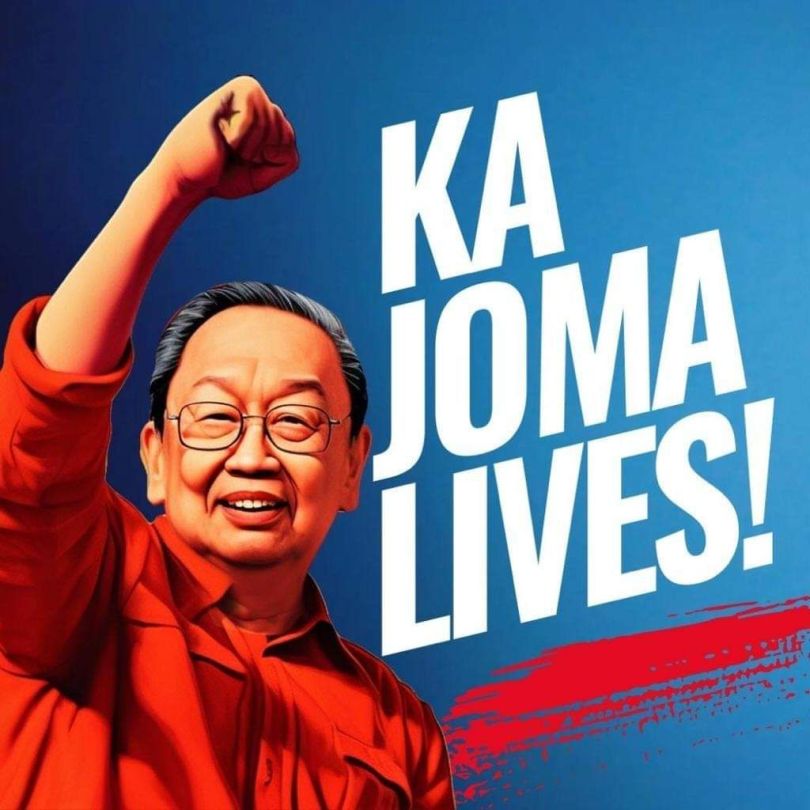
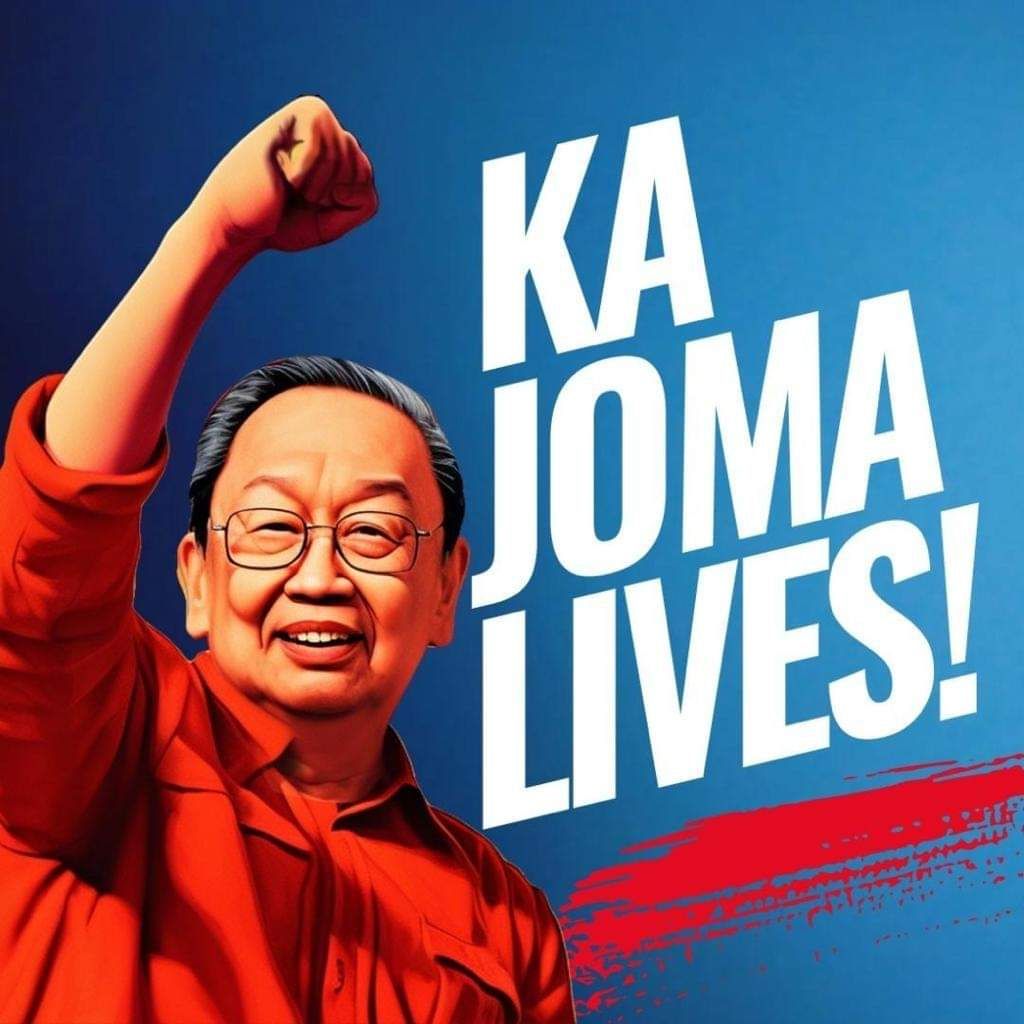
On 16 December 2022, exactly one month ago, Jose Maria Canlas Sison, known by the International Communist Movement as ‘Comrade Joma’, passed away. Passing away at the age of 83, Joma has experienced the numerous challenges, trials and tribulations, which encapsulate the life of a revolutionary party militant. As a young adult, he immersed himself in the theory of Marxism-Leninism and joined the original Communist Party of the Philippines—the Partido Komunista ng Pilipinas (PKP)—only to break away from it and reconstitute the Communist Party after criticising and exposing the revisionist and nepotist leadership of the PKP. Founding the Communist Party of the Philippines (CPP) on 26 December 1968, Joma championed the Maoist dictum of how it is right to rebel—to rebel against the military dictatorship of Ferdinand Marcos, to rebel against imperialism and the capitalist system as a whole, and to rebel against the many forms of revisionism and reformism that deter the masses from waging class struggle and seizing power. The life history of Joma is one that deserves an article, if not a book, on its own. Other Communists organisations and individuals have already provided more elaborate obituaries that chronicle Joma’s life and overall achievements, so it is neither this article’s intention nor its scope to address all these matters.1
While I was not all too familiar with Joma personally, I interviewed him for an extrapolitical assignment three years ago. During this interview I had the privilege to ask him an assortment of questions, ranging from questions concerning his childhood to questions concerning how he experienced the trials and tribulations of a revolutionary party militant. Unfortunately, as a result of extenuating circumstances, I am not able to locate the actual external hard drive that contains the three-to-four hour footage of my interview with Joma. That being said, I do vividly recall certain moments in which Joma expressed insightful remarks, which I love to share with others.
The Revolutionary Persona
When I conducted my interview with Joma, I more or less intended to just have him talk about his personal youth, how he became acquainted with the Marxist ideology, and how it all led to him being where he was at the time—a revolutionary in exile who maintained an active relationship with the communist movement in the Philippines while living in Utrecht, the Netherlands. That being said, there were definitely moments in his life that intrigued me and led me to inquire further on those aspects. At a young age, he was already perceptive of the fact how communism was demonised by the ruling establishment yet it was communism that provided a solution to the oppressive and exploitative conditions that kept the Philippines restricted and subordinated to the interests of imperialism. He participated in mass work as a Communist during a time that it was not only illegal to be a Communist, but that it was also punishable by death.
Despite living in increasingly repressive circumstances, Joma was not undeterred to form a lasting romantic relationship with his lifelong comrade Julie de Lima and form a family in the process. In terms of his experience as a revolutionary who had to navigate both a revolutionary and an interpersonal life, he told me that there was this saying that if you have a lot of strength and knowledge in something that you should share it or give part of that strength to those lacking. This applies not only to romantic relationships but also relationships involving comrades and friends. In other words, if you are in a relationship with someone in which they are rather lacking in political strength, that should motivate you even more to share your strength and knowledge with them. It is a process that requires patience and understanding, and to not conflate contradictions and misunderstandings with what is incorrigible. It is definitely the best route to support others in the process of being on a comparable political level, to share your insight and strengthen one another, and—to some extent—set yourself up as an example for others to follow or be inspired and motivated by. Evidently, Comrades Joma and Julie strengthened one another in terms of politics and knowledge as can be seen in the fact that Joma’s writings were always the result of comradely team effort. Those who aspire to be revolutionaries themselves occasionally ask themselves to what extent they need to make individual sacrifices in the name of the revolution. The typical answer to such a question tends to be one that borders on ‘lifestylism’ in which the aspiring revolutionary constructs a ‘revolutionary persona’ deprived of individuality and personal desires but one dedicated to the struggle. Historically, revolutionaries tend not to be this type of revolutionary person—and Joma is not an exception. In fact, throughout the interview, it became clear to me that Joma’s revolutionary persona was one that loved life with delight and enthusiasm yet at the same time recognised political necessities. As both the repressiveness of the Philippines’s state apparatus and the advancement of the revolutionary movement intensified, Joma accepted the reality of living underground as a revolutionary party militant. This not only meant abandoning his house and breaking off contact with various friends and family members, but it also meant that he had to have his children taken care of by comrades living in China in order to protect them from Marcos’s repressive machinations.
When I asked him if he was ever afraid of torture or death given the repressive circumstances he was active in, he told me that what he experienced was not fear but rather “cautiousness, carefulness” or “vigilance”. He was not unfamiliar with the sensation of fear, but when it came to facing the risks and dangers of being an underground revolutionary, he articulated his cautiousness in the sense of needing to be more vigilant, “to exercise prudence“. Joma was strongly aware of the dangers that a revolutionary could face but he did not experience this awareness in a paralysing sense, which is truly admiring. We Communists, especially those living in the imperialist countries who have yet to face the full brunt of the bourgeois state’s repressiveness, take revolutionary courage for granted. It is not the absence of fear, cautiousness, or vigilance, but rather it is the conscious recognition of these dangers yet marching onwards undeterred. “If you are afraid of death then you may need to reconsider a different career“, Joma told me laughing. When inquiring his experiences as an underground revolutionary, he told me that when it comes to recruiting new people, especially from dangerous areas or enemy occupations such as the military, it is better to leave the recruitment process up to cadre who are more familiar with those scenes. He admitted that there is always a level of risk no matter how small. According to him, a revolutionary party must always try to minimise the risks and dangers—preferably, one must try to have a plan B and plan C in case the initial plan fails. Reflecting on the events that led to his capture in 1977, he told me that it is important to always be on your guard, to not get careless, and to stick to party protocol. One of the reasons Joma ended up getting raided and captured by the military police was because he compromised his vigilance and went against party protocol by not concealing his face with a helmet or mask. It also did not help that when the military police raided his safe house, Joma and Julie were in a compromised position, i.e. they were unarmed and lacked immediate means to escape. In the end, however, as revolutionary you just have to place trust in your comrades. You must be capable of trusting them, placing your faith in them, he stressed.
Additionally, Joma shared the fact that he was subjected to torture by Marcos’s men. I recall feeling uncomfortable inquiring further regarding this traumatic ordeal, but Joma himself was rather open and lucid in terms of sharing his thoughts and memories. He told me that his tormentors were essentially ‘all bark and no bite’ given the fact that they avoided hitting his face, meaning they would never go to the fullest length in terms of inflicting physical torture. Even so, according to Joma, the physical torture he experienced was nothing compared to the protracted psychological torture he experienced in the form of solitary confinement. When I asked him if it ever crossed his mind to give in to the torture, he told me that the worriedness he felt towards his comrades—especially the potential consequences if he were to provide information to the enemy under duress—was much stronger than the pain and torment he constantly had to bear. Indeed, given the possible consequences of ‘spilling the beans’, relenting was not an option to Joma.
The Revolutionary Optimist
Most importantly, however, Joma told me that “there is fun in making revolution. Those are the more overwhelming things; rather than fear, prudence, or the fear of death“. What was the most important for a revolutionary, according to him, was to “[act] according to conviction, [having] a just cause and having fun. It is fun to have good comrades“. When he shared with me that optimistic and rather endearing perspective, I felt taken aback. This is usually not something you hear people talking about within serious and battle-hardened revolutionary discourse, yet here I had before me someone who had faced repression and death numerous times, who had lost innumerably comrades and loved ones in the process, yet to him the life and struggle of the revolutionary was not only one of unrelenting trials and tribulations but also one of memories and bonds that are to be cherished. Perhaps it was his communist morale in light of the moments he cherished the most, in which he struggled and shared both adventures and misadventures with his comrades, that pushed him to carry on the fight.
When looking back on the various enemies he had to face—whether they were Filipino dictators, Western imperialists, or revisionists—it was not a bitter sense of anger that dwelt in his heart, but rather an ironic sense of ‘gratitude’, which is not too different from how Mao Zedong would talk about his enemies at times. Joma thanked his enemies for pushing him further into the proletarian camp because of the immense challenges and sufferings he had to face throughout his life, which only further sharpened his understanding that there can be no peaceful coexistence between the bourgeoisie and the oppressed and exploited people of the world. His various hardships only made it clearer to him that US imperialism and the Filipino national comprador bourgeoisie were vile and rotten to the core.
The last thing I can recall is asking Sison what his final advice would be for aspiring revolutionaries. Fortunately, I managed to write down his advice: “The biggest challenge is you can get killed. But, you know, what is the communist spirit, you know? You may not see the victory of one battle—in the first battle, you might get finished off. But of course, if you have a good collective, a good movement going on, with correct ideology and political line—political military line, then it does not matter, you know. […] If you are not willing to die, you cannot engage in armed revolution. But it does not mean that you are going to ask for it. You have to do everything [in order] that you will be the one who will finish up your enemy instead of them finishing you up.”
Unfortunately, that was the last time I would meet and interact with Joma alive. While I can take solace in the fact that he imparted various messages in the books I purchased from him and his comrades of the National Democratic Front of the Philippines (NDFP)—notwithstanding the fact that he signed one of my copies of Quotations From Chairman Mao Tse-Tung—I would rather talk to him one last time. There are still so many questions I have, so many insights I wish I could receive from him. Oral history writing is extremely valuable to the International Communist Movement, I would say. Even if people’s ideas are never truly lost but instead find continuation in the revolutionary movement that inherits the struggles of the past, it definitely feels like we are deprived of the rich experiences and insights of our veteran comrades whenever they depart the realm of the living and enter the great void. Thus, while I wish I could inquire and directly learn more from Joma, I am already grateful for the first and only interview I conducted with him.
Hopefully, in the near future, I might be able to locate the hard drive and subsequently provide more interesting information that I ascertained through interviewing him. In the meantime, I wish everyone the best of luck in their revolutionary endeavours, wherever you might be.
Red salute to the great proletarian leader of the revolutionary cause in the Philippines!
Ka Joma Lives!
Until victory, always!
References
- If one is more interested in a comprehensive assessment of Joma’s life and contributions in light of the International Communist Movement, I would direct them to the statements and obituaries written by the Communist Party of the Philippines, the Communist Party of India (Maoist), the International Communist League, Revolutionaire Eenheid, and Joshua Moufawad-Paul,
 Red Spectre Writings